
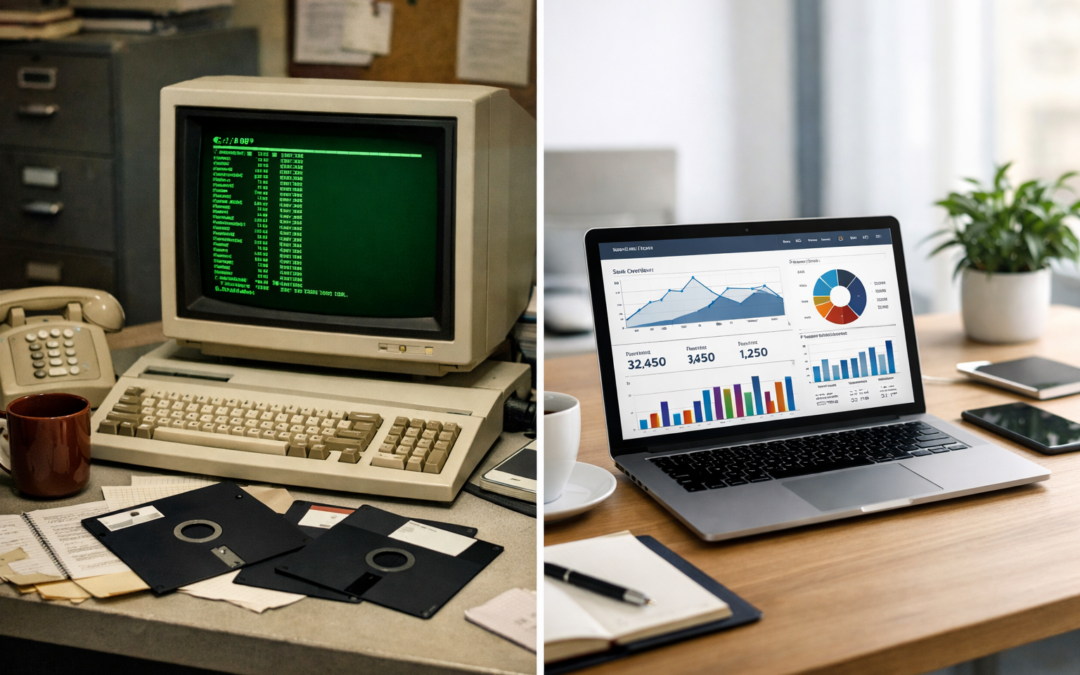
March 21, 1989. That’s when it started.
My first client was a small company running everything on paper. Actual ledger books. Handwritten entries. The kind of bookkeeping that required good penmanship and a sharp pencil.
We were moving them to BPI. A DOS-based accounting system from ACCPAC. No mouse. No Windows. Just a blinking cursor and a lot of keystrokes.
The office manager was a one-person operation. She handled the books, answered the phones, dealt with vendors, kept the whole place running. And now she had to learn an entirely new way of doing her job. While still doing her job.
After our training sessions, she’d meditate. Not as a wellness trend. Because she was overwhelmed.
I don’t blame her. She was learning something completely foreign while her bosses wouldn’t even pick up the phone during our sessions. Every interruption meant backtracking. Every phone call meant losing her train of thought.
So I said something.
I pointed out that every interruption extended the training … and extended my invoice. Suddenly, the bosses found time to answer their own phones.
That was my first lesson in ERP consulting: the software is the easy part. The people are the hard part.
What’s Changed: Everything
Back then, there was no way to import data from paper ledgers. Clients typed in every customer, every vendor, every open invoice. One by one. From handwritten records. Into a system they barely understood.
Now? We have migration tools. We export from the legacy system, clean up the data, and import it into the new one. What used to take weeks of manual entry now takes days of careful mapping and validation.
The technology has changed beyond recognition:
- DOS → Windows → Cloud. I’ve migrated clients through every era.
- Fax orders → EDI → E-commerce integrations. I’ve watched order entry go from paper to fully automated.
- Stand-alone PCs → Networked servers → Hosted systems. I’ve helped clients stop worrying about their server closet.
- Manual reports → Real-time dashboards. I’ve seen CFOs go from waiting days for financials to pulling them up on their phones.
I’ve moved clients off systems you’ve probably never heard of … DacEasy, BPI, Peachtree DOS, ACCPAC DOS … and onto modern platforms that would’ve seemed like science fiction in 1989.
What Hasn’t Changed: GIGO
Garbage In, Garbage Out.
It was true in 1989. It’s true today.
You can have the best software on the market. The slickest interface. The most powerful reporting engine. But if your data is messy, incomplete, or outdated, your new system will be just as useless as the old one.
Before every migration, I tell clients the same thing: we need to clean house first.
- Customers who haven’t ordered in five years? Archive them.
- Vendors you haven’t used since 2018? Don’t bring them over.
- Items with descriptions like “MISC PRODUCT DO NOT USE”? Delete them.
- Open invoices from a decade ago that will never be collected? Write them off.
The new system isn’t a fresh start if you’re dragging all your old messes into it.
This is the conversation nobody wants to have. Cleaning data is tedious. It forces decisions that have been deferred for years. But it’s the difference between a system that works and a system that everyone hates.
What I Never Saw Coming
In 1989, I couldn’t have predicted:
- That I’d still be doing this 36 years later. And still learning.
- That some clients would stay with me for decades. I have clients I’ve migrated through three, four, even five systems over the years.
- That the human challenges would stay exactly the same. People still resist change. Still fear new systems. Still need someone to advocate for them during training.
- That “the cloud” would mean something other than weather.
But here’s what surprises me most: companies are still running on systems that should’ve been retired years ago.
I just finished a migration from DacEasy. A system that hasn’t been updated in over a decade. The company was holding it together with workarounds and prayers, terrified that one Windows update would bring everything down.
They didn’t know what they were missing. They thought manually emailing invoices one at a time was just how it worked.
It’s not.
What 36 Years Taught Me
- The software is never the whole story. Training, buy-in, clean data, and realistic expectations matter more than features.
- Advocate for the person doing the work. That office manager in 1989 taught me that. If leadership doesn’t protect training time, the implementation will struggle.
- Don’t automate a broken process. If your workflow is a mess on paper, it’ll be a mess in software. Fix the process first.
- “Good enough” has a shelf life. Every system that’s “working fine” today will eventually hit a wall. The question is whether you’ll migrate on your timeline or the system’s.
- Trust is everything. Clients don’t stay for 30 years because of software. They stay because they trust you to tell them the truth… even when it’s not what they want to hear.
The Work Hasn’t Changed
The tools are better. The interfaces are prettier. The integrations are more powerful.
But the core work is the same as it was on March 21, 1989:
- Understand how the business actually runs, not how the org chart says it should.
- Clean up the data before it poisons the new system.
- Train the people, not just the software.
- Be the person who answers the hard questions honestly.
If you’re running a system that’s held together with workarounds, or you’re drowning in spreadsheets because your software can’t keep up, that’s the work I do.
I’ve been doing it for 36 years. And I’m not done yet.